
How to Teach Children to Help Without Expecting Something in Return?
 Barbara Pivarcsi, MSc
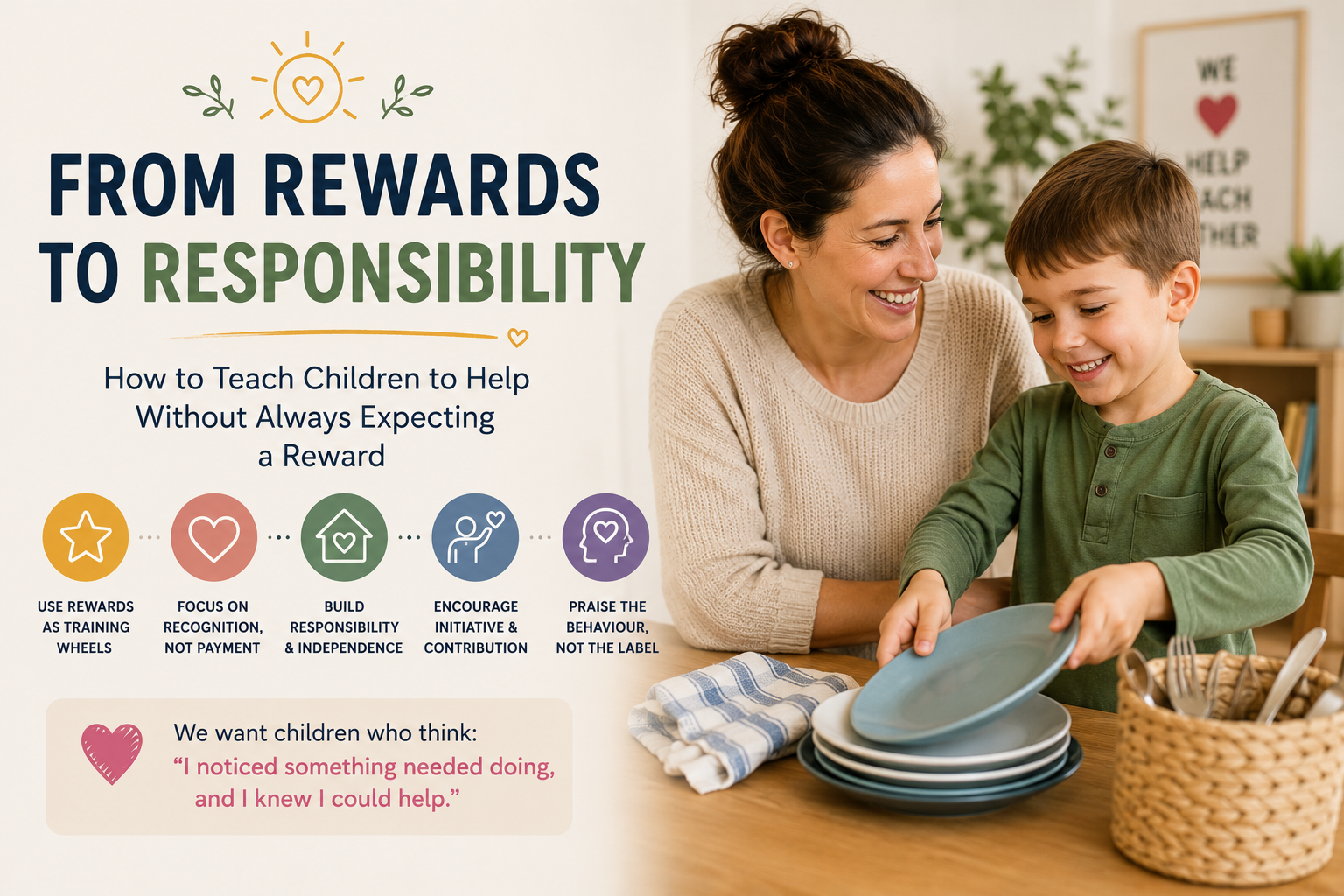
How to Teach Children to Help Without Always Expecting Something in Return
Stars, stickers, points and even small coins can be useful when teaching children new habits. But many parents and caregivers eventually encounter an unexpected response:
“What do I get if I do it?”
If every helpful action comes with a reward, children may begin to see helping as a transaction: I do something for you, and you give me something in return.
So how can we use rewards while still raising children who notice when something needs doing and genuinely want to contribute?
Rewards Can Be Training Wheels
Rewards can be particularly useful when establishing a new, clearly defined behaviour.
Imagine teaching a child to bring their plate to the kitchen after eating.
At first:
“When you finish eating, remember to bring your plate to the kitchen. Then you can add a star to your chart.”
But don't make the star the most important part.
Add specific encouragement:
“You remembered your plate without me doing it for you. You did that independently!”
There is good reason to be thoughtful about how rewards are used. A major meta-analysis by psychologists Edward Deci, Richard Koestner and Richard Ryan, covering 128 experiments, found that certain expected tangible rewards can reduce intrinsic motivation, particularly when rewards become the reason for doing an activity. Positive feedback, however, was associated with increased intrinsic motivation.
This doesn't mean rewards are bad. It means they are best used as a tool for establishing behaviour rather than the permanent reason for it.
The goal isn't to eliminate rewards. It's to know when to move beyond them.
Move From Reward to Recognition
Once the behaviour becomes familiar, begin reducing the reward.
Instead of a star every time:
“Thank you for bringing your plate back. That helped me clear the table.”
Now something important has changed.
The child's attention moves from:
“What did I get?”
toward:
“What did my action do?”
Children begin to see that their contribution has a real effect on the people around them.
Research into children's household responsibilities supports the broader value of giving children opportunities to contribute. A 2019 longitudinal study involving 9,971 children found that doing household chores in kindergarten was associated with later self-competence, prosocial behaviour and self-efficacy.
The study does not prove that chores caused these outcomes, but it suggests that ordinary family responsibilities can provide meaningful opportunities for children to experience themselves as capable contributors.
Some Responsibilities Don't Need Payment
It can help to distinguish between everyday responsibilities and extra jobs.
Putting toys away, carrying your plate back, putting dirty clothes in the laundry basket and cleaning up something you spilled can gradually become normal parts of family life.
The message is:
“We all contribute because we live here together.”
Extra jobs can be different.
An older child might earn a small amount for washing the car, cleaning shutters, completing a bigger garden task, or helping with another agreed job beyond their usual responsibilities.
This teaches children that responsibility and paid work aren't the same.
Start Rewarding Initiative
Once basic responsibilities become habits, shift your attention toward something even more valuable: noticing without being asked.
Perhaps your child sees you carrying shopping bags and comes to help.
Instead of immediately reaching for a coin, say:
“I didn't even ask you. You noticed I needed help and came over. That was really thoughtful.”
Or your child notices that their younger sibling dropped something:
“You saw that she needed help and helped her by yourself.”
Sometimes there might be a star. Other times, the recognition itself is enough.
The aim is to develop the habit of looking around and thinking:
“Is there something I can do?”
This is also where rewards can gradually give way to something more powerful: the child's own sense of competence, responsibility and contribution.
Praise the Behaviour, Not the Label
Instead of relying mainly on:
“You're such a good boy!”
try describing what actually happened:
“You kept trying even though it was difficult.”
“You worked that out yourself.”
“You remembered without being reminded.”
“You noticed what needed doing.”
“Look how quickly we finished because we worked together.”
Research led by Elizabeth Gunderson and Carol Dweck followed children whose interactions with their parents had been observed between the ages of 1 and 3. Children who received more process praise, where praise was focused on their effort, actions, and strategies, later showed stronger beliefs that abilities can develop and a greater willingness to embrace challenges.
Classic experiments by Claudia Mueller and Carol Dweck found something similar. Children praised for their effort responded more positively to setbacks than children praised for being intelligent, including showing greater persistence after failure.
So instead of focusing only on who the child is:
“You're so clever.”
we can draw their attention to what they did:
“You tried another way when the first one didn't work.”
Everyday responsibilities can therefore become opportunities to reinforce something bigger than obedience:
“I can learn. I can try. I can solve problems. I can contribute.”
From Reward to Responsibility
A useful way to think about the process is:
Reward → Recognition → Responsibility → Initiative → Identity
At first:
⭐ “I help because I get a star.”
Later:
“My effort is noticed.”
Then:
“This is something I'm responsible for.”
Eventually:
“I noticed something needed doing, and I knew I could help.”
That's the destination.
Stars, stickers and coins don't have to be the enemy of intrinsic motivation. Used thoughtfully and temporarily, they can help establish new habits. The important part is knowing when to step back and allow responsibility, competence and the satisfaction of contributing to take their place.
Because ultimately, we're not trying to raise children who constantly ask:
“What do I get?”
We're helping them discover:
“I can do this. I can help. I can contribute.”
Comments (0)
Sign in to leave a comment
Sign In